

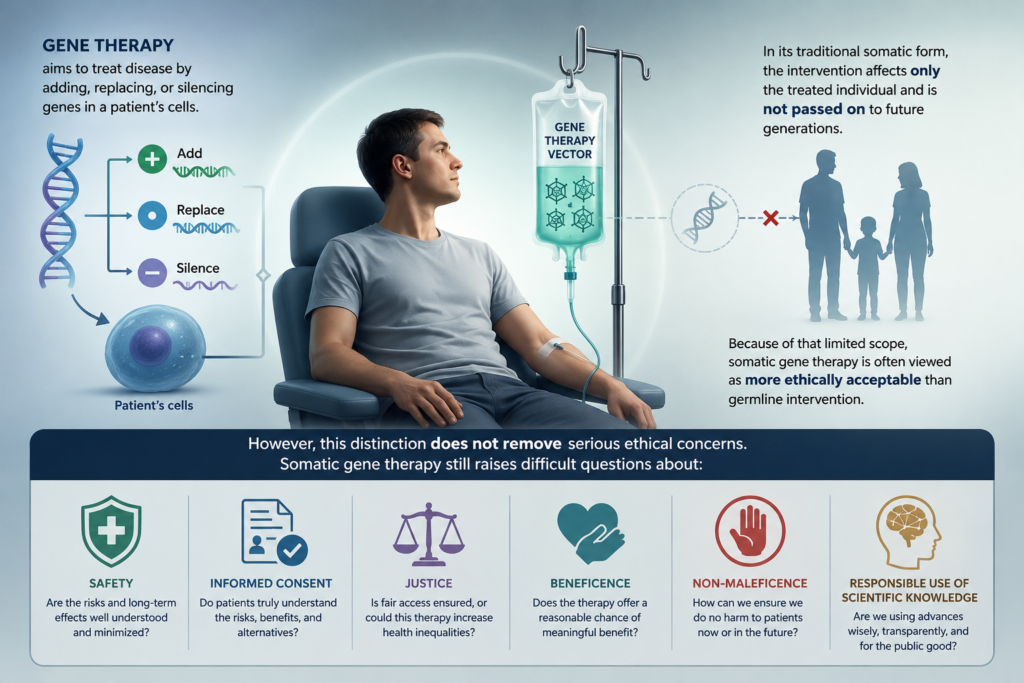
Gene therapy aims to treat disease by adding, replacing, or silencing genes in a patient’s cells. In its traditional somatic form, the intervention affects only the treated individual and is not passed on to future generations. Because of that limited scope, somatic gene therapy is often viewed as more ethically acceptable than germline intervention. However, this distinction does not remove serious ethical concerns. Somatic gene therapy still raises difficult questions about safety, informed consent, justice, beneficence, non-maleficence, and the responsible use of scientific knowledge.
This paper argues that traditional gene therapy is ethically acceptable only when its risks are proportionate to its likely benefits and when it is researched, tested, and delivered with strong protections for patients. The key ethical question is whether the potential benefits justify the uncertainties, especially in early-phase clinical trials where direct therapeutic benefit may be limited.
Using the Jesse Gelsinger case as a central example, the discussion shows how somatic gene therapy challenges autonomy, fairness, patient welfare, and public trust in biomedical research.
Ethical Concerns and Considerations
Traditional somatic gene therapy is ethically significant because, unlike germline intervention, it does not affect future generations. Even so, limiting the biological effects to one patient does not eliminate ethical difficulty. The central concerns arise from uncertainty: researchers may not fully know the short-term or long-term effects of introducing genetic material into the body, especially through novel vectors and delivery systems.
From a safety perspective, the main risks include immune reactions, dose-related toxicity, unintended effects in non-target tissues, and uncertainty about long-term outcomes. Ethical use therefore requires strong preclinical evidence, careful dose escalation, independent monitoring, and long-term follow-up. A therapy is not ethically acceptable simply because it is non-heritable; its risks must also be scientifically justified and clearly explained.
These safety concerns are closely tied to autonomy and informed consent. Patients in early trials are often seriously ill and may confuse research with treatment. Ethical consent therefore requires more than a signature: participants must understand that early-phase studies primarily test safety rather than guarantee benefit, and they must be told about meaningful uncertainties and prior warning signs.
Beneficence and non-maleficence remain in tension. Somatic gene therapy may offer real benefit when other treatments are limited or ineffective. At the same time, the obligation to avoid harm means researchers must minimize foreseeable risks and justify exposing patients to uncertainty. As possible harms become more severe or less predictable, the ethical burden of justification becomes stronger.
Justice raises another concern. Many advanced gene therapies are extremely expensive, which prompts questions about who bears the risks of research and who benefits from success. Ethical problems emerge when vulnerable participants assume the burdens of experimentation while resulting therapies remain inaccessible to most patients. In that sense, the ethics of somatic gene therapy involves not only biological risk, but also fairness, transparency, and equitable access.
The Jesse Gelsinger Case
The Jesse Gelsinger case remains one of the most important examples in the ethics of gene therapy because it shows how scientific ambition can outpace patient protection. In 1999, Gelsinger, an eighteen-year-old enrolled in a clinical trial for ornithine transcarbamylase deficiency, died after receiving an adenoviral vector intended to deliver a corrective gene.
The case became a turning point because it raised concerns about whether known risks were adequately disclosed, whether prior adverse findings were properly weighed, and whether conflicts of interest influenced research conduct. Ethically, it showed that innovation must be guided by transparent risk communication, meaningful independent oversight, and a consistent commitment to participant welfare.
Several lessons follow from the case: safety must take priority over speed or prestige; informed consent must be meaningful rather than procedural; adverse events and preclinical warning signs must be reported and taken seriously; oversight bodies must be willing to slow or stop studies when risk becomes unacceptable; and public trust in gene therapy depends on ethical conduct.
These lessons continue to shape ethical analysis of somatic gene therapy today by reinforcing the importance of transparency, caution, and accountability in research.
- The experimental nature of the treatment,
- The possibility of severe harm,
- The fact that early-phase trials are mainly designed to test safety, not guaranteed benefit, and
- Any prior adverse findings that could affect their decision.
Conclusion
Traditional somatic gene therapy may be more ethically acceptable than germline intervention because it affects only the treated individual and does not alter future generations, but it still raises serious ethical concerns. When examined through the principles of safety, autonomy, justice, beneficence, and non-maleficence, it becomes clear that the moral value of somatic gene therapy depends not simply on its medical promise, but on how responsibly it is researched and applied. The Jesse Gelsinger case demonstrates that scientific innovation without adequate safety protections, transparent informed consent, and independent oversight can cause profound harm and undermine public trust. For that reason, traditional gene therapy is ethically defensible only when patient welfare remains the highest priority and when its risks, benefits, and broader social consequences are carefully governed.
Bibliography:
Steerling, E., Houston, R., Gietzen, L.J., Ogilvie, S.J., de Ruiter, H.P., Nygren, J.M. (2022). Examining how Ethics in Relation to Health Technology is Described in the Research Literature: Scoping Review. Interactive Journal of Medical Research.
Elena A. & Theodore H. Health Technology, Quality, Law, and Ethics. The New Public Health. Wilson, J.M. (2009). Lessons learned from the gene therapy trial for ornithine transcarbamylase deficiency. Molecular Genetics and Metabolism.
NYU Langone Health, High School Bioethics Project. Gene Therapy Research & the Case of Jesse Gelsinger (learning guide).
The Hastings Center. Addressing Gene Therapy’s Ethical and Policy Challenges (commentary/news resource).
World Health Organization. (2019). Ethical considerations for health policy and systems research. WHO Publication.
U.S. Department of Health and Human Services (HHS), Office for Human Research Protections. The Belmont Report: Ethical Principles and Guidelines for the Protection of Human Subjects of Research.
European Medicines Agency (EMA). Guideline on follow-up of patients administered with gene therapy medicinal products.
Hayden, E.C. (2001). Harm, ethics committees and the gene therapy death. Journal of Medical Ethics.
Kimmelman, J. (2008). Who killed Jesse Gelsinger? Ethical issues in human gene therapy.
Journal of Genetic Counseling.
Finsinger, S., & colleagues. (2023). Bioethics of somatic gene therapy: what do we know so far? Current Medical Research and Opinion.
Sarewitz, D. (2019). The price of progress: ethical and policy challenges for high-cost gene therapies. (Policy commentary).
Markkula Center for Applied Ethics. Bioethics Cases. Case studies on health care and biotechnology ethics.
Steven E Goune, MBA, MCiM
June 2026